Parts & Older Doors
What Happens When a Sliding Door Roller Is Discontinued?
One of the more interesting parts of this trade starts after the door is already on the work table: the roller comes out, there is no readable part number, and the original assembly has not been sold for years.
That does not automatically mean the door has to be replaced.
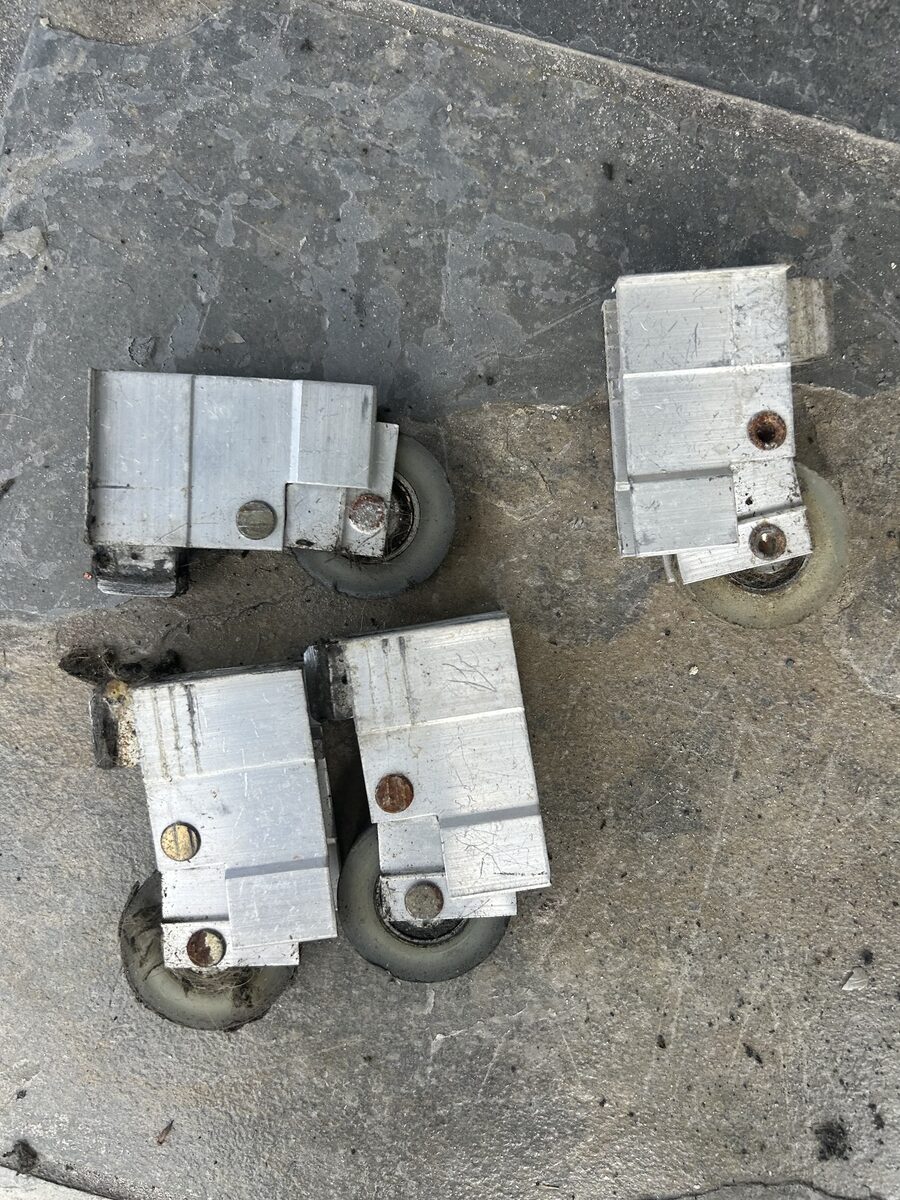
Older sliding doors often use hardware that was shared across several manufacturers or produced by a supplier rather than the door brand itself. We identify the assembly by physical characteristics: housing length and width, wheel diameter, wheel width, axle position, mounting tabs, adjustment screw location, single- or tandem-wheel layout, and the space available inside the door rail.
This is also why Delta sources compatible hardware through suppliers and manufacturers in the U.S. and abroad. Modern hardware companies produce heavy-duty, adjustable and multi-fit roller systems for many door profiles. The correct solution may be an exact replacement, a recognized successor part, or a compatible assembly whose dimensions and load requirements match the original system.
We do not recommend improvising with a roller simply because it fits into the opening. The wheel has to meet the track correctly, the panel has to adjust to the proper height, and the assembly has to support the door safely.
Our roller replacement service includes this identification work when needed. For an older door in St. Augustine or Jacksonville, finding the right hardware can take more research than installing it. That research is often what saves a serviceable door from unnecessary replacement.
What we look at before recommending a repair
A useful diagnosis starts with the complete moving system. We operate the panel through its full travel and pay attention to where resistance begins, whether the resistance changes as the door moves, whether the panel rocks, and whether lifting slightly on the handle changes the way it rolls. Those details help separate a wheel or bearing problem from a damaged running surface or an alignment issue.
Next comes the lower track. We look for dents, flattened areas, pitting, corrosion, raised edges and evidence that metal has been dragging instead of rolling. We also look at the panel height and the gaps around the frame. If one side is sitting lower, that can affect the lock and weather contact even when the lock itself is still functional.
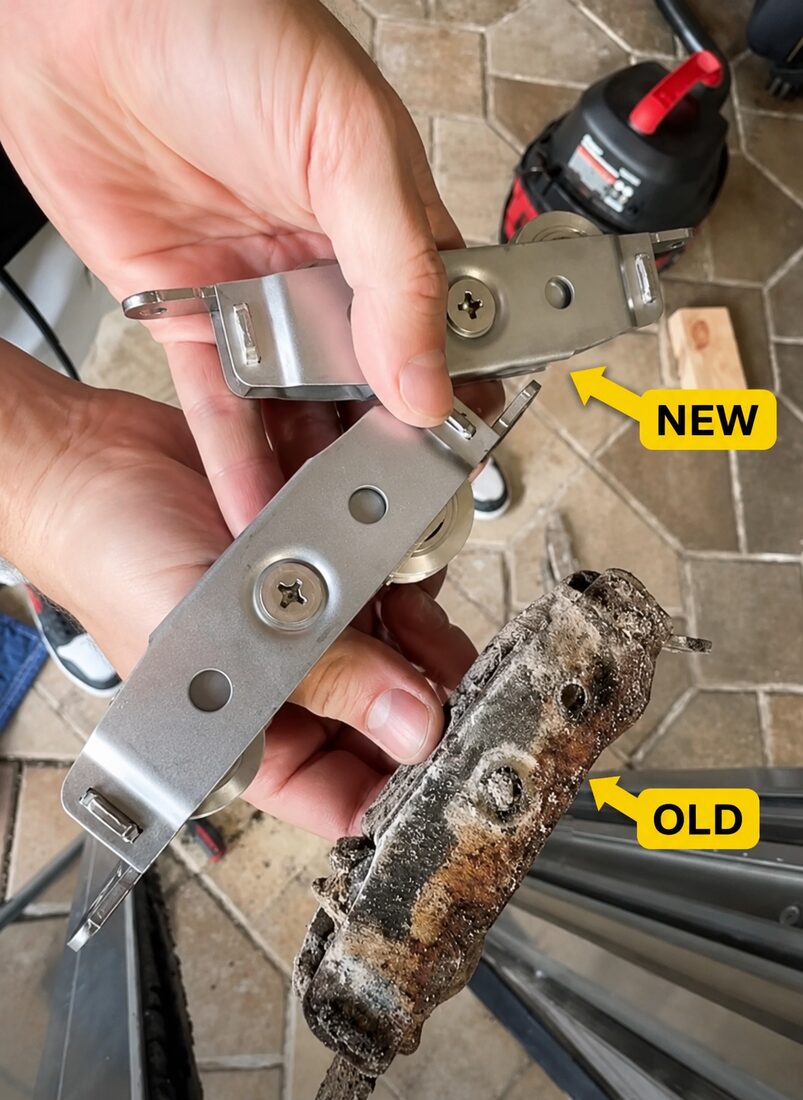
When the roller assembly has to come out, identification becomes much more precise. Housing length, width and height, wheel diameter, wheel width, axle location, mounting style, adjustment-screw position and single-versus-tandem configuration can all matter. On a heavy panel, load capability matters as much as physical fit.
That is why we avoid diagnosing an older door from one exterior photo. A photograph can show the symptom; the hardware inside the bottom rail usually tells the rest of the story.
Why part identification matters
There is no single universal patio-door roller. Hardware manufacturers produce different housings, wheel materials, wheel diameters, adjustment ranges and multi-wheel configurations for different door profiles and loads. A part can look close enough on a phone screen and still be wrong once it is installed.
For older systems, the brand name on the glass or frame is only one clue. Door companies have changed hardware over the years, and some used components made by outside hardware manufacturers. The original part may also have been superseded or discontinued.
Our process is therefore measurement first, sourcing second. We look for an exact replacement when one is available. If it is not, the next question is whether there is a recognized successor or mechanically compatible assembly that meets the door's dimensional, track and load requirements. Delta sources compatible hardware through suppliers and manufacturers in the United States and abroad when that is what the repair requires.
The objective is not to make an unusual part fit. The objective is to restore the way the panel is supported and adjusted without creating a new problem elsewhere in the system.
A practical identification sequence
When markings are missing, we work from the geometry of the assembly. The old carriage is removed and photographed from several angles before measurements are taken. We note whether the wheel is concave, flat or otherwise shaped for a particular running surface; whether there is one wheel or a tandem pair; how the axle sits in the housing; and how the adjustment screw moves the inner carriage.
We then compare the available space inside the bottom rail. A replacement housing that is a little too tall can prevent proper adjustment. A wheel with the wrong profile can contact the track incorrectly. A unit with insufficient load capability may fit on the bench but perform poorly under the panel.
Sometimes the exact old assembly is still available through specialty replacement-hardware channels. Sometimes a later version replaced it. In other cases, a compatible assembly can be selected by dimensions and mechanical requirements. The decision is made from the door outward, not from a catalog photo inward.
Questions homeowners often ask
Can this problem usually be diagnosed without replacing the whole door?
Often, yes. The useful first step is identifying the failed component and checking the condition of the surrounding system. The age of the door by itself does not determine whether it is repairable.
Can you give an exact repair price from a photo?
Not reliably. Delta provides a free on-site estimate because roller type, track condition, panel weight, hidden hardware and secondary damage can change the scope of the repair.
Can the repair sometimes be completed during the same visit?
When the customer approves the estimate and the correct parts are available, many common repairs can be completed during the same visit. Unusual or discontinued hardware may require additional sourcing.
Should I keep using the door if it is grinding or becoming very heavy?
It is better to avoid forcing it. Continued use can turn a worn component into additional track, handle, lock or frame damage.
Need the door inspected?
Delta Sliding Doors provides free on-site estimates. We inspect the door in person, explain what is causing the problem, and provide the price before work begins. If you approve the estimate and the required parts are available, many repairs can be completed during the same visit.
How the symptom changes the diagnosis
A door that is uniformly heavy from one end of the opening to the other suggests a different problem from a door that catches at one exact point. A rhythmic bump that repeats with wheel rotation suggests something different from a long scrape. A panel that moves better when slightly lifted gives us another clue. None of those observations proves a diagnosis by itself, but together they narrow the possibilities.
We also ask what changed. Did the door become heavy gradually? Did someone recently adjust it? Was the track struck by furniture or construction equipment? Did the lock stop lining up at the same time the movement became worse? Has the panel been removed before? Those details can reveal whether we are dealing with normal wear, secondary damage or an earlier repair that never addressed the cause.
What a successful repair should feel like
The finish line is not simply “the door moves.” The panel should travel without grinding or repeated impact, sit at an appropriate height, meet the frame consistently and lock without being lifted into position. The rollers and track should work as a pair rather than fighting each other.
After hardware work, final adjustment matters. Too low and the frame can scrape; incorrectly set and the lock may miss its keeper. A smooth door is the result of correct parts plus correct setup.
Want it looked at in person?
Delta gives a free on-site estimate across Jacksonville & 75 miles around.